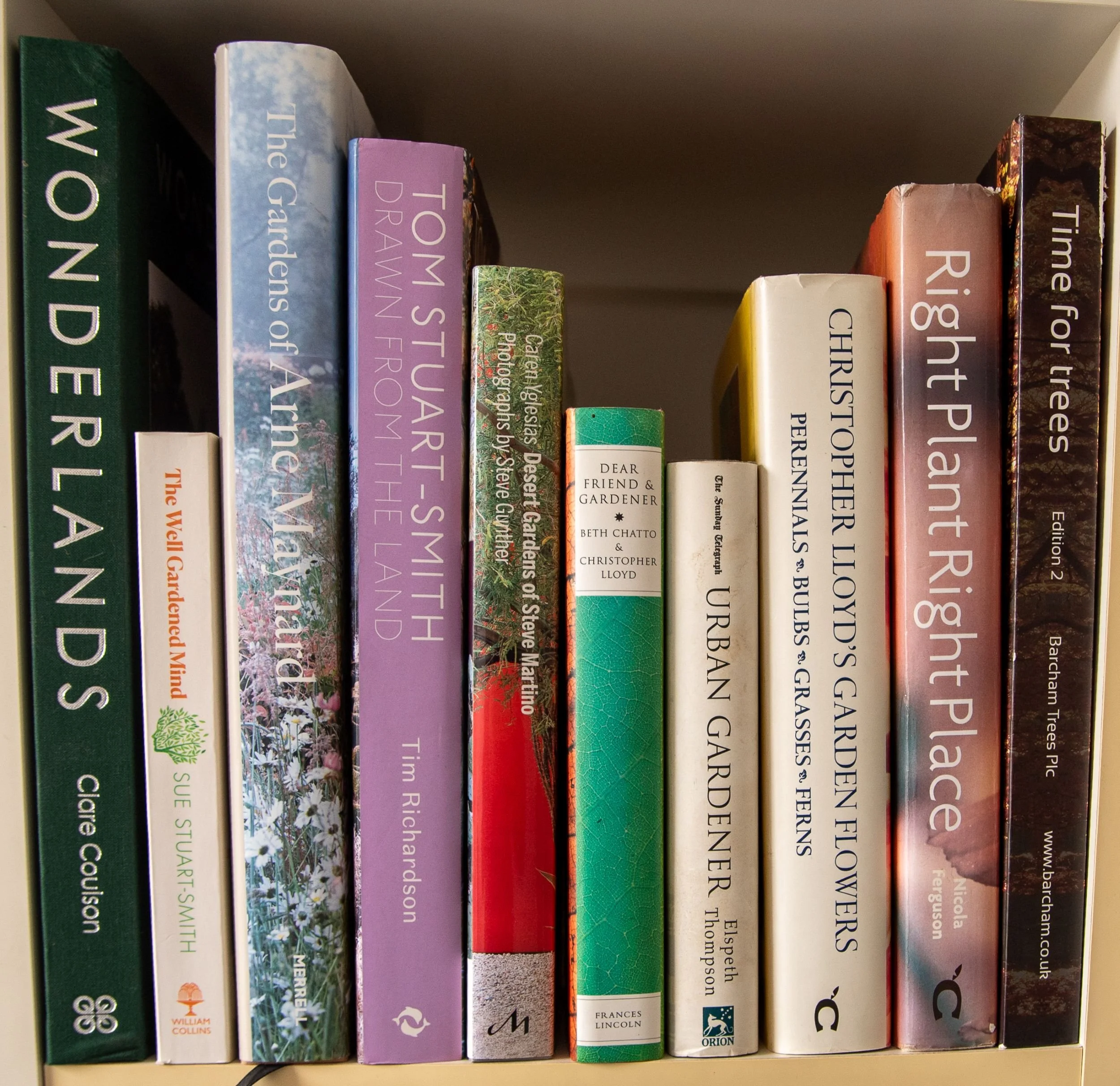
My top ten garden books
It’s winter. I’m not a great one for curling up by the fire with a seed catalogue. They’re usually very wordy, short on pictures, with anodine sowing and cultivation notes. A book about gardens, or plants, plant hunting or gardening however, is much more cup of tea. But so much depends on the author and, naturally, the photographer.
First off, the books I use the most for my work. No, they are not technical tomes about soil composition of how to haunch the edge of a patio, but primarily books about plants.
The most thumbed book on my whole bookshelf is Right Plant Right Place by the late Nicola Ferguson. The phrase was first coined by Beth Chatto, if you plant something in the best possible position for it it (almost) can’t fail. And the most referred to chapters are those about planting in shade. London gardens are notoriously shady, be they in the shadow of tall buildings, neighbours’ trees or even their own fences. Every garden has got a slightly unloved corner where it would seem almost nothing will thrive. Beth Chatto might have had the number on planting under trees in her Woodland Garden book, but Nicola trumps her when it comes to dry shade and dense shade. Other valuable chapters are on plants for heavy clay soils and long flowering perennials.
Once I’ve made a selection for a garden I like to have a quick look at Christopher Lloyd’s Garden Flowers. No glamorous photos here but at times quite a witty take, and 70+ years of experience, on the delights or failings of many popular garden flowers. Recently, in looking for spring bulbs for a client I came across his description of Camassia quamash, “whose Indian (native American) name, quamash, indicates their edibility with its onomatopoeic, scrunching sound.” He admits to making that up but thought it should be true. Not that I agree with him all the time, one of my favourite flowers, the bright blue Catananche caerulea, is described as “a mildy pleasing but second-rate plant.”
The third of this trio of reference books is Barchams Time for Trees. Barchams is the tree supplier to the King, and the Queen before him. Obviously there’s some self-interest in this book and I was given it for free at a trade fair. However, it has lots of photos and good descriptions of hundreds of garden trees. It is particularly good at describing many different culitvars, I can’t tell you how useful this is when eyeing up several different varieties of cherries or magnolias say. It’s much easier to compare and contrast with a book than it is online.
Now for a bit of garden writing. I’m reminded of the quote that “writing about music is like dancing about architecture” and so how can writing really convey to the reader anything about a garden? The answer is, in the way that detective novels are fascinating but do not reveal the true awfulness of a murder, garden writing is enjoyable without actually having to get dirty or cold and wet or do your back in or weed that border for the nth time … Here are three that I’ve really enjoyed.
Back in the day when people actually wrote letters, and complete sentences, Christopher Lloyd and Beth Chatto enjoyed a very lengthy correspondence. Subjects ranged from writing about their own gardens, each other’s gardens, lots of other gardens, lots of (to my mind) unfathomable advice and there’s some terrific name-dropping thrown in too. The resultant book, Dear Friend and Gardener, is so good I’ve got two copies.
Sadly it seems most of the writers featured so far are no longer with us. Both Christopher Lloyd and Beth Chatto lived to ripe old ages at least, proving that gardening is indeed good for you. Elspeth Thompson, in the ordinary course of events should still be alive, but she suffered from depression and took her own life at the age of 49. Gardens can’t heal all it seems. She left two books, the first of which is The Urban Gardener, three years of Telegraph columns about the trials and triumphs in her garden and allotment in inner city London.
This brings me to my third choice for garden writing, Sue Stuart-Smith’s The Well-Gardened Mind. Sue is married to the Tom Suart-Smith (more of him later) and is a psychiatrist. In an age of well-ness, biophilia and other 21st century tropes, here is an evidence-led exploration of not only why gardening is good for you, but how gardening is good for you. Thankfully this is not a self-help book but is rewarding and uplifting with lots of case studies.
The final group of books are ones I turn to in need of inspiration or just a dose of garden porn if you like. None of these bears any relation to either my own garden or indeed the suburban gardens I design. I can but dream…
First up, Tom Stuart-Smith’s Drawn from the Land. Beautiful gardens and beautiful photography. The gardens range from award winners at the Chelsea Flower Show, London courtyards, country house gardens, a Moroccan paradise garden, arid Mediterranean hillsides and many gardens open to the public. I’ve been lucky enough to see a few of these in the flesh and he never disappoints.
Another monograph I’ve enjoyed is The Gardens of Arne Maynard. Much more associated, in my mind at least, with the gardens of ancient houses and landscapes. Unashamedly romantic and definitely not low maintenance, he particularly favours old fashioned roses, topiary and often features bucolic kitchen gardens. I’ve also seen a couple of his gardens, including his own in Monmouthshire which is one of my favourites. The photography, mostly by William Collinson, is lovely.
This next one is a bit left field and never in my wildest dreams would I ever be asked to design anything in this sort of landscape, let alone with this level of style and minimalism. The Desert Gardens of Steve Martino are designed and built in the semi-desert-like region of south-western USA. An early pioneer in the use of native plants adapted to the arid landscapes which are sometimes subject to heavy downpours, his gardens use walls to construct views and create privacy to making beautiful minimlaist outdoor rooms. If you want to see gardens which are the complete opposite of, say, Arne Maynard, this is the designer to look at. Fabulous photography by Steve Gunther.
My last choice, published earlier this year, is Wonderlands. Written by Claire Coulson and photographed by Eva Nemeth, it is an exploration of the gardens of some well-known and not so well-known British garden designers. I was in two minds about including this book as mostly I feel deep seated envy when I look at this book. Included are the gardens of Tom Stuart-Smith and Arne Maynard. Interestingly, few of these designers admit to having any plans for their own gardens. They’ve taken a more experimental and leisurely approach, unpressured by a deadline or a budget or a client brief. Even so, there are deep echoes of their professional work in their own gardens.
The joy of allotmenteering
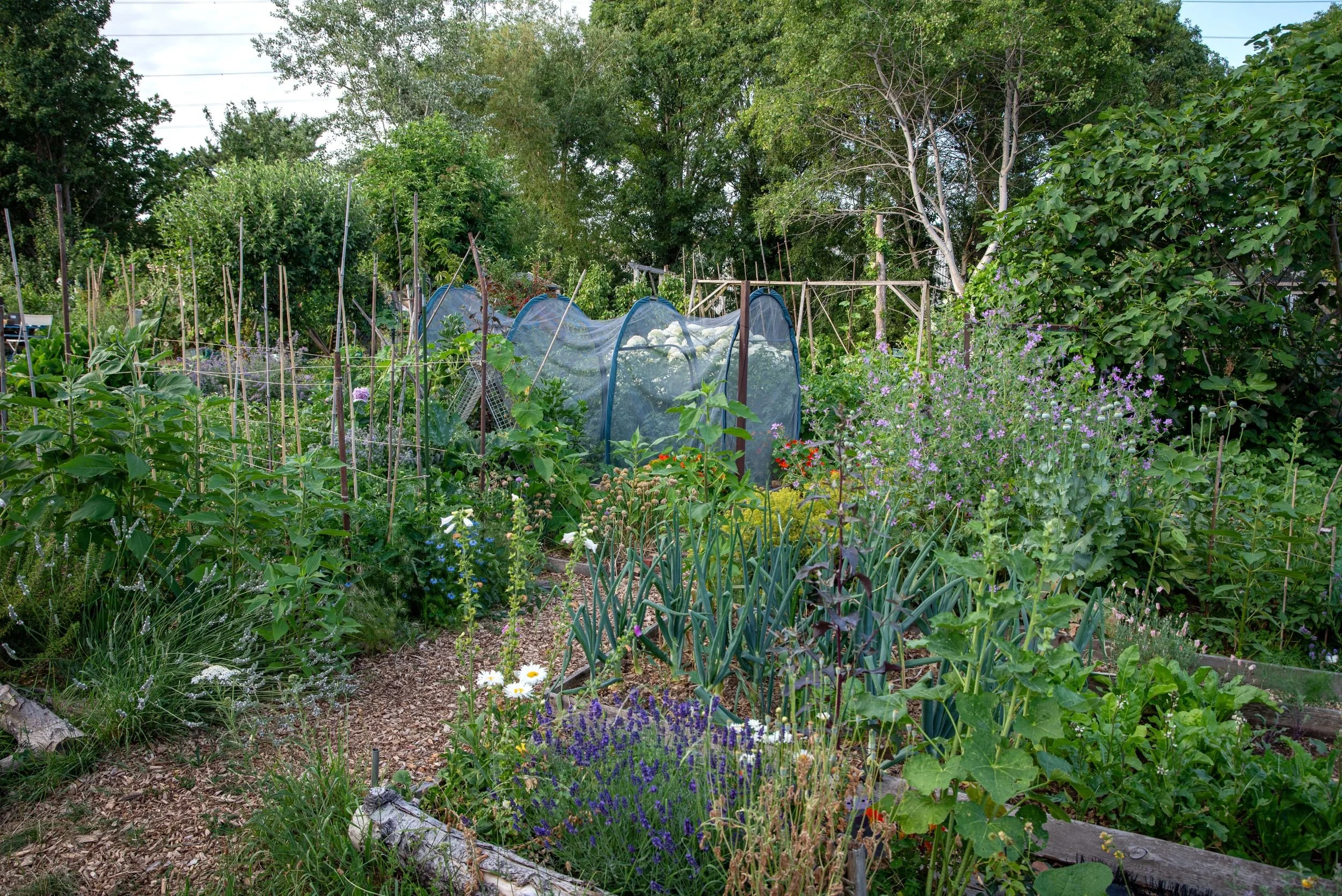
Every summer our group of park gardening volunteers organises a walking tour of some of our own gardens. This summer we visited two allotments gardened by three of our group.
Allotments seem to be a uniquely British institution. Small areas of land are rented, usually from the local council, to grow fruits, vegetables and plants. Some people keep bees and hens and grow flowers for cutting. Allotments can vary in size but usually measure ten rods or poles, which is around 250 square metres.
Allotments have their origins in the late Anglo-Saxon/early medieval period when large fields were divided into thin strips for individuals or families to grow crops. This was known as the open-field system.
By the late 1500s these fields were divided up to be used only by the owner. They were then enclosed through a series of Acts of Parliament. In compensation, ‘allotments’ of land would be attached to tenant cottages - the first written reference to allotments in the UK.
Allotments as we know them today stem from the General Enclosure Act of 1845 that made provision for ‘field gardens’ to be used by the landless poor—although very little enclosed land was actually set aside for this purpose. The later ‘Small Holdings and Allotments Act’ of 1907 and 1908 imposed responsibilities on councils to provide allotments if there was a demand for them.
There was a huge increase in allotment use during the First and Second World Wars due to the shortage of imported food. Disused railway land, public parks and private gardens were all used to grow fruit and vegetables. The ‘Dig for Victory’ in the Second World War produced 1.3 million tonnes of food from 1.5 million allotment plots.
There was a steady decline in allotment use after the wars but this slowed during the 1970s when TV shows like the BBC’s The Good Life inspired interest in food production and self-sufficiency.
Since the 1990s, there has been a lot of renewed interest with concerns about climate change and foodprovenance, and the benefits of spending more time outside means that demand has rapidly oustripped supply.
The waiting list for the allotments in these photos can be up to eight years. Increasingly there is pressure to change the use from allotments to housing. Recently there has been an increase in the number of private allotments. The cost of these is significantly higher than council-owned ones.
In Merton there are only three council owned allotments and new applications are no longer being accepted. From the statistically insignificant sample of the one allotment site I visited I would say around 20% of the allotments looked they had been abandoned.
It seems to take a long time for these to be declared available for new users. Allotments can deteriorate quickly, becoming invaded with pernicious weeds (and wildlife). It can take six months of hard slog to clear the ground of brambles, bind weed, even himalayan balsam, requiring a lot of determination to keep going.
On the plus side you may inherit established perennial plants such as fruit trees and currant bushes. You may also inherit the shed (every allotment has one) in any state of repair, and assorted accumulated allotment accoutrements such as old baths, gazillions of bamboo poles, untold plastic pots but also greenhouses, paths, edging and well-rotted compost.
Many people take on allotments as they’d like to grow their own food. However, it is apparent that the community of allotmenteers keeps people going. There is lots of advice (whether you want it or not), community get togethers and community resources to share (the wild blackberries and large manure heap here spring to mind).
To the causal observer allotments can look a bit of a mess. Allotmenteers are nothing if not thrifty and resourceful, making use of many household items that might otherwise be thrown away. However, they are also havens of peace and quiet, full of wildlife (mostly welcome…) and provide a much needed escape from urban life.
Long live allotments!