
What are the health and well-being benefits of a designed garden?
Recently I was asked this exact question. It took me a few moments to articulate something that I’d always taken for granted. Everyone knows gardens and gardening are good for you, right? And it stands to reason that a designed garden must be even better. But why?
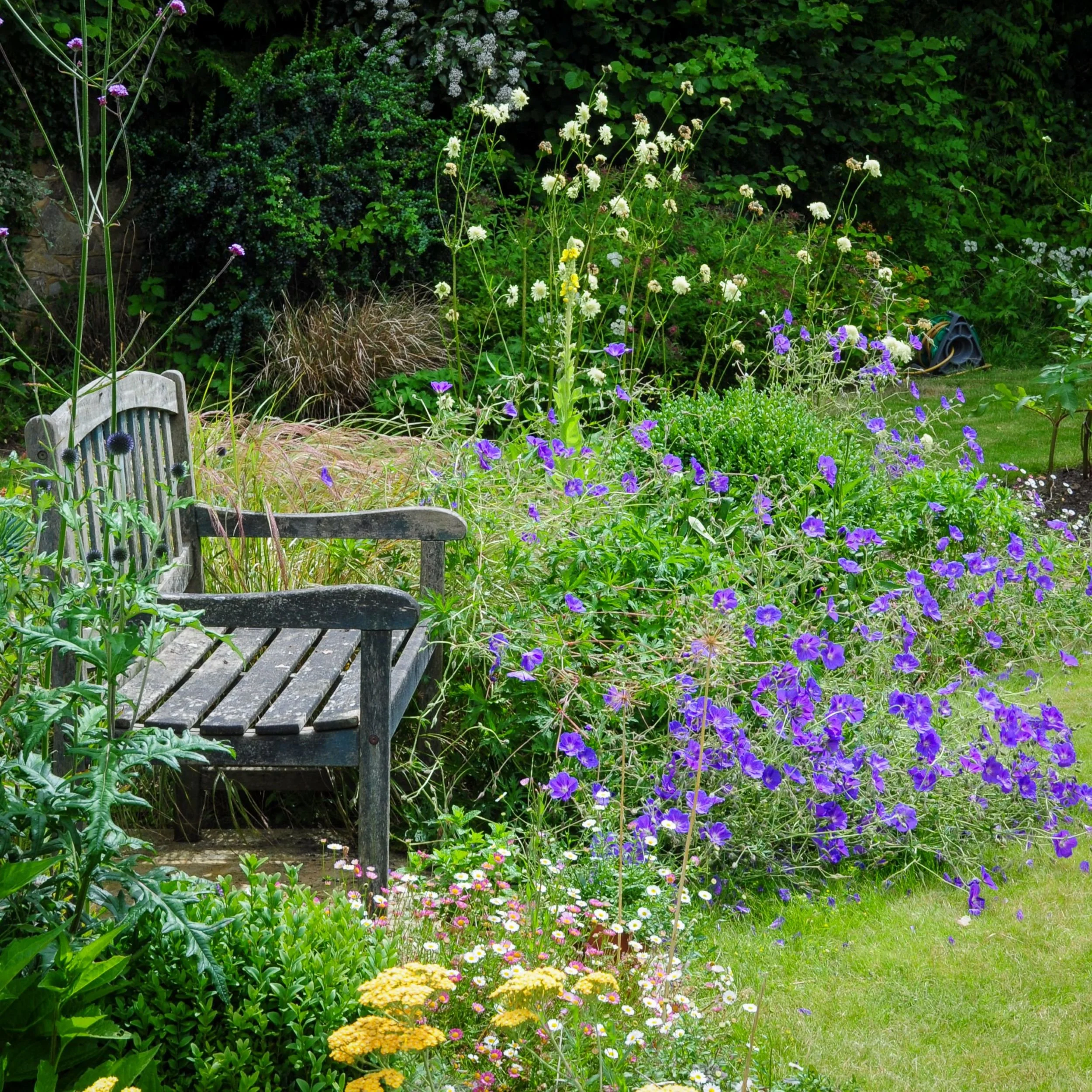
There's a particular kind of client meeting, usually towards the end of a cup of coffee, when they say "I just want somewhere I can sit and switch off." Not a wish-list of plants, not a pergola, not even a lawn for the kids. Just somewhere to switch off. I used to think this was a slightly evasive answer to "what do you want from your garden?" Now I think it might be the only honest one most people give me.
And there's plenty of research backing this up. Sue Stuart-Smith, who I've mentioned before, wrote The Well-Gardened Mind largely to explain why digging about in soil seems to do something for the brain that almost nothing else does. Cortisol drops. Mood lifts. The endless scrolling, half-attentive fatigue of modern life — what the researchers rather grandly call "directed attention fatigue" — gets a chance to recover. None of this is news to anyone who's spent an hour pottering around and looked up to find their shoulders have dropped two inches.
But here's the bit I find more interesting, and the bit that's relevant to what I actually do for a living: a garden that's been designed does this better than one that's just evolved.
I don't mean "designed" in the sense of expensive or showy. I mean considered. A garden that someone has actually thought about, rather than one that's accumulated by way of whatever was on offer at the garden centre that Saturday, or whatever the previous owners left behind. There's a difference between a space you've inherited and a space that's been made for you, and your nervous system seems to know which is which.
Take shade. Almost every London garden has a corner where nothing seems to want to grow — under a tree, behind a fence, in the lee of next door's extension. Left alone, that corner becomes the place you avoid, a small patch of guilt and bare earth that reminds you the garden isn't quite working. Planted properly — and here I'll happily send you back to Nicola Ferguson's Right Plant Right Place, my most-thumbed book for exactly this reason — that same corner becomes somewhere genuinely lovely to sit. The plants thrive because they're where they want to be. You feel better in the space because it isn't fighting you. That's not a coincidence; it's the whole point of putting the right plant in the right place.
Then there's the business of having somewhere to retreat to. Most of the gardens I admire most — Arne Maynard's own garden in Monmouthshire is one — have a spot that isn't really for show. It's tucked away, a bit private, somewhere you'd take a coffee and not be seen from the kitchen window. That's a deliberate design decision, not an accident, and it matters more than people expect. Having a quiet corner that's yours, away from the house and its various demands, turns out to be doing quite a lot of the psychological heavy lifting that "switching off" requires.
There's a social side too, which is easy to overlook when you're picturing a garden as a solitary retreat. A well-placed table, a path wide enough for two people and a pushchair, raised beds at a height someone with a bad hip can actually use — these are all design choices, and they're the difference between a garden that gets used by the whole family and one that just gets looked at from the sofa. I think about this a good deal more than clients expect me to. It's not really about plants at all; it's about who gets to be in the space, and how easily.
And then, frankly, there's the exercise. Nobody hires me because they want a reason to go to the gym less, but a well-designed garden tends to get you out into it — mowing, dead-heading, propping up a leaning rose, having a poke about to see what's coming up. It's moderate activity dressed up as pottering, which is probably the most sustainable kind of exercise there is, because you don’t notice you’re doing it..
None of this is to say a wild, unplanned garden can't be good for you too — plenty of the best ones are. But there's something particular about a space that's been made with intention, where the awkward corners have been solved rather than ignored, and where there's somewhere to sit that actually wants you to sit there. Elspeth Thompson's columns were full of the daily, scruffy reality of gardening — the failures as much as the triumphs — and she'd have been the first to tell you gardens can't fix everything. But a well-designed one does seem to make the fixing of everything else a little more bearable.
Which is, I suspect, what most people mean when they ask for somewhere to switch off.