

Waterperry Gardens
Waterperry Gardens, in Oxfordshire, is a veritable cornucopia of all things horticultural, edible, cultural and shoppable. The gardens themselves are extensive and would need a visit of several hours to do them justice.

The Truth Trail
The Gardens rose to fame in the middle of the 20th century as a residential horticultural college for women run by Beatrix Havergal (allegedly the inspiration for Roald Dahl’s Miss Trunchbull). The college closed on the death of her life and business partner, Avice Sanders, in 1971.

The Herbaceous Border
Beatrix and Avice originally founded the school in 1921 at Pusey House in Oxfordshire and moved to Waterperry Gardens in 1932. At the time it was rented from Magdelen College.until they bought it in 1948. All students paid their own fees until 1958, when scholarships were granted by some county councils. The diploma was accepted as one equal to those issued by Kew and Edinburgh. Beatrix was awarded an MBE in 1960 and the Royal Horticultural Society Veitch Memorial Medal and Victoria Medal of Honour in 1965. For many years Beatrix won gold medals for her strawberries at Chelsea Flower Show.

The Herbaceous Border
The property was bought by The School of Philosophy and Economic Science in 1971. Beatrice and Avice’s garden has been maintained as they knew it and it has also been extended in scope and content, although it is not clear what is original and what is new.

The canal
The gardens are large and quite varied. You are guided into the gardens along the Truth Trail, over a bridge and through light woodland. Under another bridge the long herbaceous border suddenly appears. It is banked up on oneside alllowing plants to tower over the pedestrian.

Silent Space
The Formal Garden was created by Bernard Saunders and Mary Spiller, a former student and then tutor at Waterperry Horticultural School. The sculpture, Girl holding the Lamp of Wisdom, is by Nathan David. It is a Silent Space, part of a network of gardens of where people can be silent and switch off from the outside world and to take time to reflect.

The Colour Border

The Colour Border
I particularly enjoyed the Colour Borders - these colour co-ordinated mixed borders make use of perennials, shrubs, bedding and bulbs to give all year round colour and interest.

Modern Border

Modern Border
The Modern Borders look good at the end of summer with grasses and later flowering perennials. The wavy edges are reminiscent of the 1970s.

Walled Garden

Walled Garden

Walled Garden
The Georgian Walled Garden has been recently made over as a cutting garden. The deep borders of Dahlias are pretty spectacular as are the beds of colourful annuals. I managed to miss The Mary Rose Garden, Yew Henge and orchards - more to see on another visit, perhaps in the spring.
Beyond the gardens there is a nursery, shops of varying descriptions, art gallery, museum, cafe and outdoor theatre. I didn’t have time to try the cafe. It would be worth taking a picnic as its a long walk to the cafe if you want refreshments part way through your visit.

Ham House
It’s been a few years since my last visit to Ham House. This time, amazingly, I went in the house and had a quick whizz round. Lots of paintings and tapestries, fab windows and staircase and really good views of the surrounding 30 acres. Mature trees mean you can’t see the Thames even though it’s only a stone’s throw away.
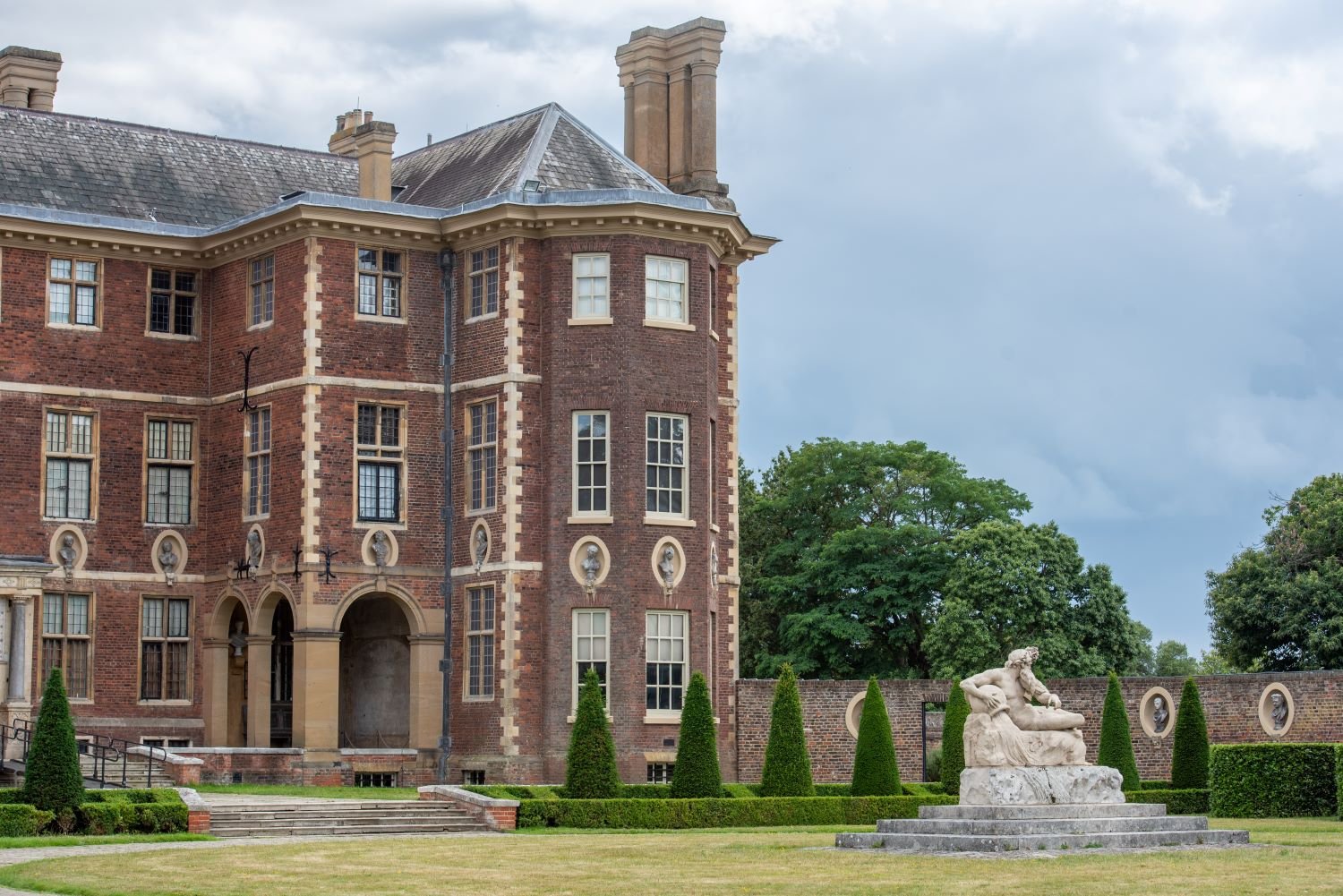
Father of the Thames in Coade stone
Ham House was built in 1610 by Thomas Vavasour, an Elizabethan courtier to James I. It was then leased, and later bought, by William Murray, a close friend and supporter of Charles I. The house achieved its greatest period of prominence following his daughter Elizabeth's second marriage—to John Maitland, Duke of Lauderdale.

Agastache, Calendula and Lavender
The design of the garden was considered as important as that of the house and has a strong French influence. There are formal avenues of trees radiating out from the house and the garden is divided into a number of smaller, though still very large by modern standards, walled areas.

Statuesque Allium Summer Drummer
The property was donated to the National Trust in 1948 but renovation of the gardens did not begin until 1975. The works have focused mainly on the Wilderness, the kitchen garden, known as the Orangery, grass squares called The Plats and the Cherry Garden. In recent years there has been a concerted effort to increase biodiversity with large areas of the grounds planted with wild flowers.
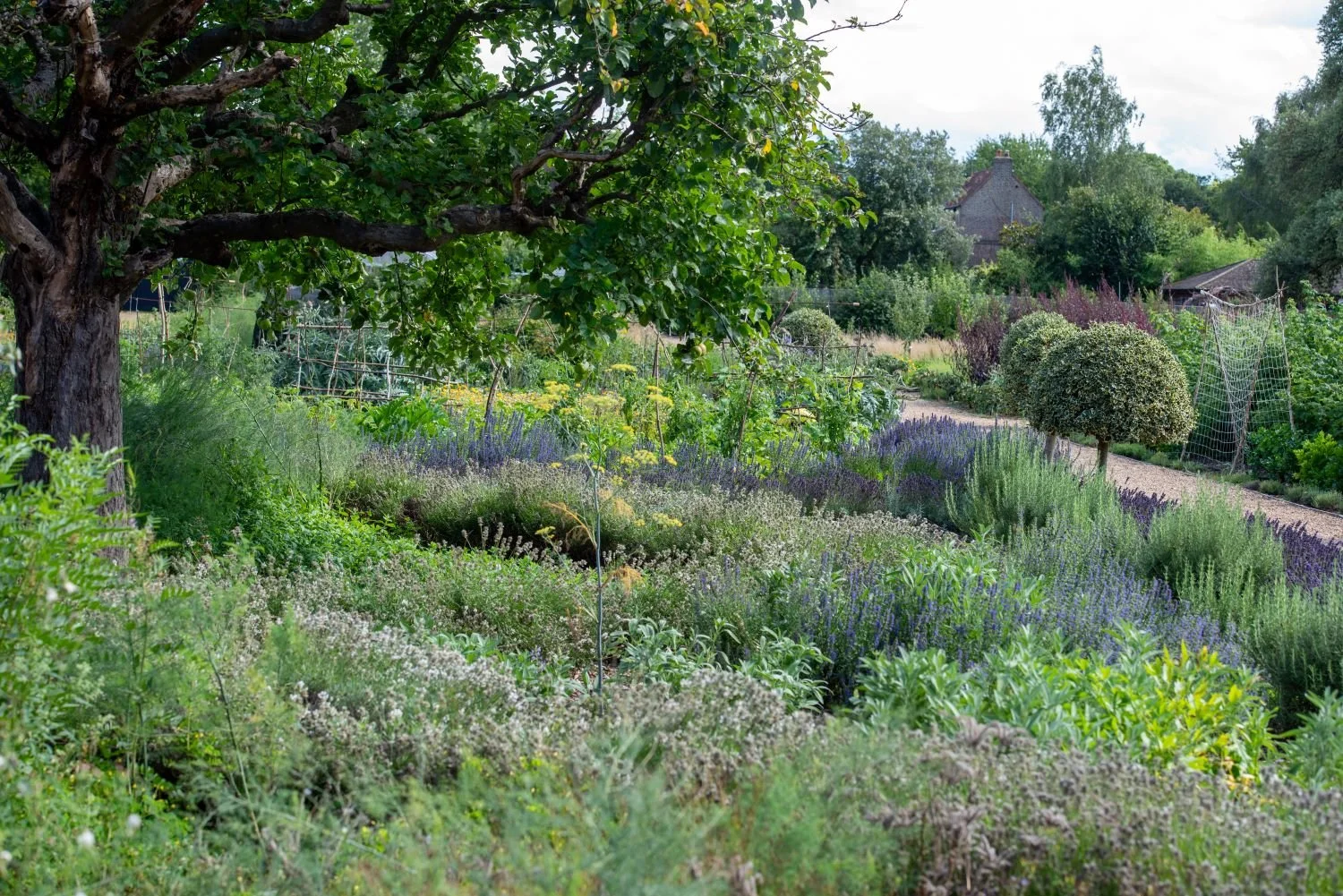
Herbs planted under an apple tree
In early August the most interesting features are the Cherry Garden and the Kitchen Garden. The latter is the most recent to be renovated and the focus is on producing fruit and vegetables for the cafe and flowers for the house. By no means does this cover the whole of the original Orangery garden.

The garden is laid out in a grid pattern with corners often marked with these topiaried variegated hollies and many of the paths are lined with lavender or teucrium.

The garden was buzzing with wildlife, mainly bumble bees and butterflies (I spotted Red Admiral, Large White and skippers). This pigeon was helping itself to the borage.

Bumblebee in the thyme

Hemerocallis
I don’t know if it was just the time of year or a deliberate design intention but the kitchen garden was overwhelmingly orange and purple - Hemerocallis, Calendula, Dahlias, Lavender, Agastache, Teucrium, Salvias - and it was very effective. The orange-red brick amplified the effect.

More Lavender and Calendula
In contrast, the Cherry Garden is a lesson in restraint, definitely a less is more approach. Although the layout of pleached tree avenues and parterre of box topiary and lavender is very 17th century French in style, all is not as it appears.

Box topiary, just trimmed
Archeological investigations in the 1980s showed no signs of a formal garden on this side of the house. Happily the National Trust has decided to keep this as a formal garden rather than be puritanical about keeping to the 17th Century design.

It is a designated as a quiet space and the limited palette of plants - pleached limes, yew hedges, box topiary and lavender - was very restful and quite modern in feel. The structure and evergreens mean this would still be a still place even in winter.

The slanting sun in late afternoon in the second half of summer gave all the edges a silvery glow, almost, but not completely, caputured in my photos.
I didn’t try the cafe although it looked very nice, situated in the kitchen garden. No doubt the fare is standard NT stuff.
There’s also a second hand bookshop (quite good, but not as extensive as the one at Mordern Hall Park). There seemed to quite a few outdoor activities for children but most seemed to be having fun just running around.
There’s parking at Ham Street Carpark or you might get lucky and park for free on Ham Street. It’s a bit of a schlep from a railway station.
If you’re out for the day you’re just a short walk from The Palm Centre (access via Cut Throat Alley….). and Petersham Nurseries (more restaurant than nursery).
Thanks to Wikipedia for a potted history.